Whitelisting and Ad Usage Rights Explained for Creators (Price Like a Pro)

Paul Osas
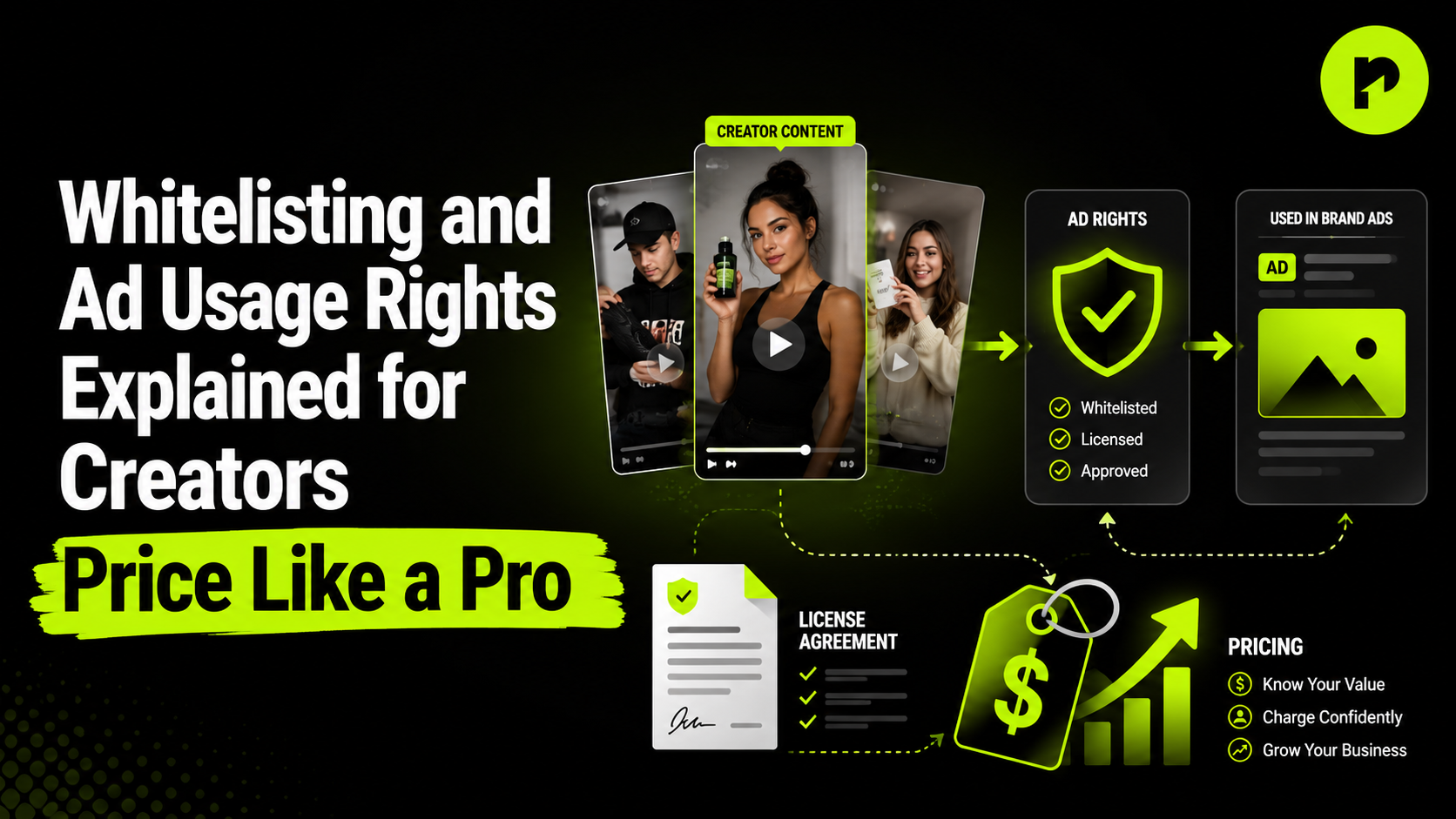
Whitelisting and usage rights confuse even experienced creators.
Picture this:
You just delivered a fantastic review video to a skincare brand. They love it. They reply to your email saying, “This is perfect! We’re going to run this as a TikTok ad and whitelist your handle. Thanks again!”
You enthusiastically reply, “Sounds great!”
Fast forward two months. Your friends are texting you because your face is appearing on every single Facebook and TikTok ad break.
The brand has made $50,000 in sales directly from your video. And how much did you get paid?
Just your $250 base rate.
You left thousands of dollars on the table because you didn't understand the contract.
Meanwhile, 51% of other influencers charge a separate fee just for whitelisting, on top of their regular content creation rate.
No, charging for whitelisting won’t make you lose a brand deal. You don’t have to panic when a marketing manager asks to "whitelist" your handle.
If you’re tired of giving away your highly profitable image for pennies, this guide breaks down exactly what whitelisting is, how it differs from standard usage rights, what you should charge, and how to protect yourself in the contract.
No jargon, no guessing.
Key takeaways:
- Whitelisting lets a brand run paid ads directly through your social account, not just your content
- Usage rights and whitelisting are different — usage rights cover reposting your content, whitelisting covers running it as ads from your handle
- Micro-influencers (10K–100K followers) typically charge $150–$500/month for whitelisting access, while mid-tier creators (100K–500K) charge $500–$2,000/month
- Whitelisting deals should always specify duration, platforms, and ad spend caps in writing
- Unclear contracts are the #1 reason creators get underpaid for usage rights
What Is Whitelisting for Creators?
Whitelisting is when you grant a brand permission to run paid ads directly through your social media account, using your handle, your engagement history, and your audience targeting data.
The ad looks like it's coming from you, but the brand controls the spend and the targeting. This is different from a brand just reposting your content on their own page.
With whitelisting, the ad appears to originate from your account (think Instagram's Partnership Ads or TikTok's Spark Ads), which means it inherits your credibility and your existing engagement.
Brands get access to your social identity, not just your video file.
Why do brands want this so badly?
Because ads that come from a real creator account outperform ads from a brand's own page.
People trust creators more than logos. In our breakdown of UGC usage rights, we explained that whitelisting preserves your engagement data and outperforms standard organic-only usage, which is exactly why brands are willing to pay extra for it.
Organic, Ad Usage and Whitelisting Rights: What are the Differences?
When a brand pays you to make a video, they do not automatically own that video. You own the copyright. They are simply buying a license to use it.
When you quote a basic rate (say, $300 for a video), that typically only includes Organic Usage.
Organic usage means the brand can post your video on their standard Instagram feed or TikTok page. They are not putting any money behind it to "boost" it to a wider audience. It just lives on their profile.
But what happens when they want to run it as a paid advertisement? That requires Ad Usage Rights (sometimes called Paid Media Rights).
So how do you do it?
You must charge extra. When a brand runs your face as a Facebook or TikTok ad, they are directly generating revenue from your likeness. You deserve a cut of that commercial success.
Whitelisting goes further to give them access to run paid ads through your actual account. The first ones are about the organic and sponsored use of the content; the other is about your identity and audience.
Here's the clearest way to think about it:
Type | What the brand gets | Where ads appear | Typical cost |
|---|---|---|---|
Organic usage rights | Permission to repost your content on their own social pages, website, or emails | Brand's own channels | Included in the base rate or a smaller add-on fee |
Ad (paid) usage rights (boosting) | Permission to run your content as an ad from the brand's own account | Ads appear as coming from the brand | Moderate add-on, usually flat fee |
Whitelisting | Direct access to your account to run ads using your handle and targeting data | Ads appear as coming from you | Highest fee, often monthly recurring |
Whitelisting means the brand runs ads from your account with content you created, and that access is billed as a monthly fee, not a one-time payment.
How to Price Ad Usage Rights
Never give away your usage rights for free. And more importantly, never give them away forever.
When you price ad usage, you should sell it in blocks of time: usually 3 months, 6 months, or 12 months. This is known as the difference between rights-managed vs unlimited UGC licensing.
Here is the industry-standard formula for pricing standard Ad Usage: Charge 20% to 30% of your base rate, per month of usage.
Let's look at a real-life example:
- Your base rate to film a video: $300
- The brand wants 3 months of Ad Usage Rights.
- 30% of $300 is $90.
- $90 x 3 months = $270.
Total Invoice: $570.
By simply understanding this rule, you nearly doubled your income from a single video. If you need a refresher on structuring these base rates, make sure your influencer rate card is up to date.
How to Price Whitelisting
Whitelisting is an add-on service. It goes on top of your base rate and your standard ad usage rate.
Why? Because you are lending them your actual audience and your hard-earned reputation. If the brand runs a spammy, annoying ad through your handle, it is your followers who will get annoyed and unfollow you. You are taking on brand risk.
Because of this, whitelisting commands a premium.
Here is the standard formula for pricing Whitelisting: Charge an additional 50% to 100% of your base rate, per month of whitelisting.
Let's revisit our example:
- Your base rate: $300
- 3 months of Ad Usage: $270
- 3 months of Whitelisting (at 50% / $150 per month): $450
Total Invoice: $1,020.
You took a $300 gig and turned it into a $1,000+ campaign, simply because you understood how to package and price your digital rights.
For more advanced strategies on bundling these fees, check out how to price UGC content like a professional
What Should Be in Your Whitelisting Contract?
A solid whitelisting agreement spells out which ad permissions the brand receives, how long the access lasts, which platforms are covered, and what happens if either side wants to end it early.
Vague contracts are where creators lose money.
Before you sign anything, make sure these terms are explicit:
(A) Duration: Exact start and end dates for the whitelisting access, not "ongoing" or "TBD"
(B) Platforms: Which specific platforms and ad formats (Spark Ads, Partnership Ads, etc.) are covered
(C) Ad spend cap: A ceiling on how much the brand can spend, so pricing stays proportional
(D) Renewal terms: Whether the deal auto-renews and how much notice you get before it does
(E) Revocation rights: Your ability to pull access early if the brand violates the agreement
(F) Exclusivity clauses: Whether you're restricted from similar deals during the term
(G) Payment schedule: Whether whitelisting is billed monthly or as a flat upfront fee
If you haven't already, read our guide on red flags to watch for in brand contracts before signing your next idea. In perpetuity is one of the most common traps we've seen creators walk into.
Spotting the "In Perpetuity" Red Flag
When negotiating whitelisting and ad usage rights, the most dangerous phrase in the creator economy is: "In Perpetuity."
This means "forever."
If a brand sends you a contract asking for "unlimited ad usage and whitelisting rights in perpetuity," you must push back. If you sign that, the brand can run ads from your face and your handle five years from now, and you won't see a single dime of the profits. Furthermore, it might prevent you from ever working with a competing brand again.
When you spot this red flag, do not panic. Use our guide to negotiating influencer contracts to send a polite, firm counter-offer.
You can reply: "I am so excited to start this campaign! I noticed the contract requests usage in perpetuity. My standard rate of $300 covers 3 months of paid ad usage. If you would like to secure unlimited usage in perpetuity, my buyout rate is $2,500. Let me know which option works best for your budget!"
Lock It Down in Your Contract

A handshake agreement over an Instagram DM will not protect you.
If you are granting a brand permission to log into your social media handles and run targeted ads, it must be legally documented. Your contract needs to explicitly state:
Which specific video is being used.
The exact start and end dates of the whitelisting period.
That the brand cannot alter or heavily edit your original video without permission.
If you don't have a lawyer on standby to draft this for you, don't worry. You can download and adapt our simple UGC creator contract template to ensure your boundaries are clearly set before you hand over any files.
When Should You Say Yes to a Whitelisting Deal?
Say yes when the fee reflects the actual value of your audience access, the contract has clear boundaries, and the brand is one you'd genuinely want associated with your account.
Say no, or renegotiate, when any of those three are missing.
A few green flags worth looking for:
- The brand provides a clear ad spend range upfront
- The contract has a defined start and end date
- You retain the right to review or approve how your content is used in the ad
- The fee is separate from your content creation rate, not folded into it
These deals start as one-off gifted or low-paid collaborations before evolving into whitelisting requests.
If you're trying to figure out when a collab is worth converting into a paid, whitelisted partnership, our post on gifted vs paid collaborations covers exactly how to make that pivot.
How Whitelisting Fits Into Your Bigger Pitching Strategy
Whitelisting isn't something you should wait for brands to bring up. It's something you can proactively pitch as part of your rate card.
Creators who mention whitelisting and usage rights options upfront in their outreach tend to land higher-value deals, because it signals they understand ad performance, not just content creation.
When you're reaching out to brand decision-makers, mention that you offer whitelisting as an add-on service alongside standard content creation.
This is also where having organized outreach matters. You need to track which brands you've pitched whitelisting to, what rates you quoted, and where negotiations stand.
PitchBrand helps here by combining verified brand contact discovery with AI-powered pitch writing, so you can mention usage rights and whitelisting terms directly in your first outreach email instead of scrambling to add it after a brand counters with a lowball offer.
If you're managing multiple ongoing whitelisting agreements with different expiration dates, a CRM built for tracking brand deals also helps you keep tabs on which brands have active access to your account and when it's time to renegotiate or revoke.
Take Control of Your Creator Business
Having whitelisting and ad usage rights explained for creators is the ultimate lightbulb moment.
You are no longer just a freelancer making pretty videos for the internet. You are a media company licensing highly valuable commercial assets. When you protect your usage rights, limit your timelines, and charge fairly for whitelisting access, your income will skyrocket without having to film a single extra video.
Stop leaving your money on the table. Update your rate card, set your boundaries, and start charging what your influence is actually worth.
Ready to put your new pricing strategy to the test?
Sign up on PitchBrand today, access our verified database of decision-makers, and start pitching brands who respect creators enough to pay for proper licensing.