UGC Rates 2026: What Creators Should Charge (Real Numbers)

Paul Osas
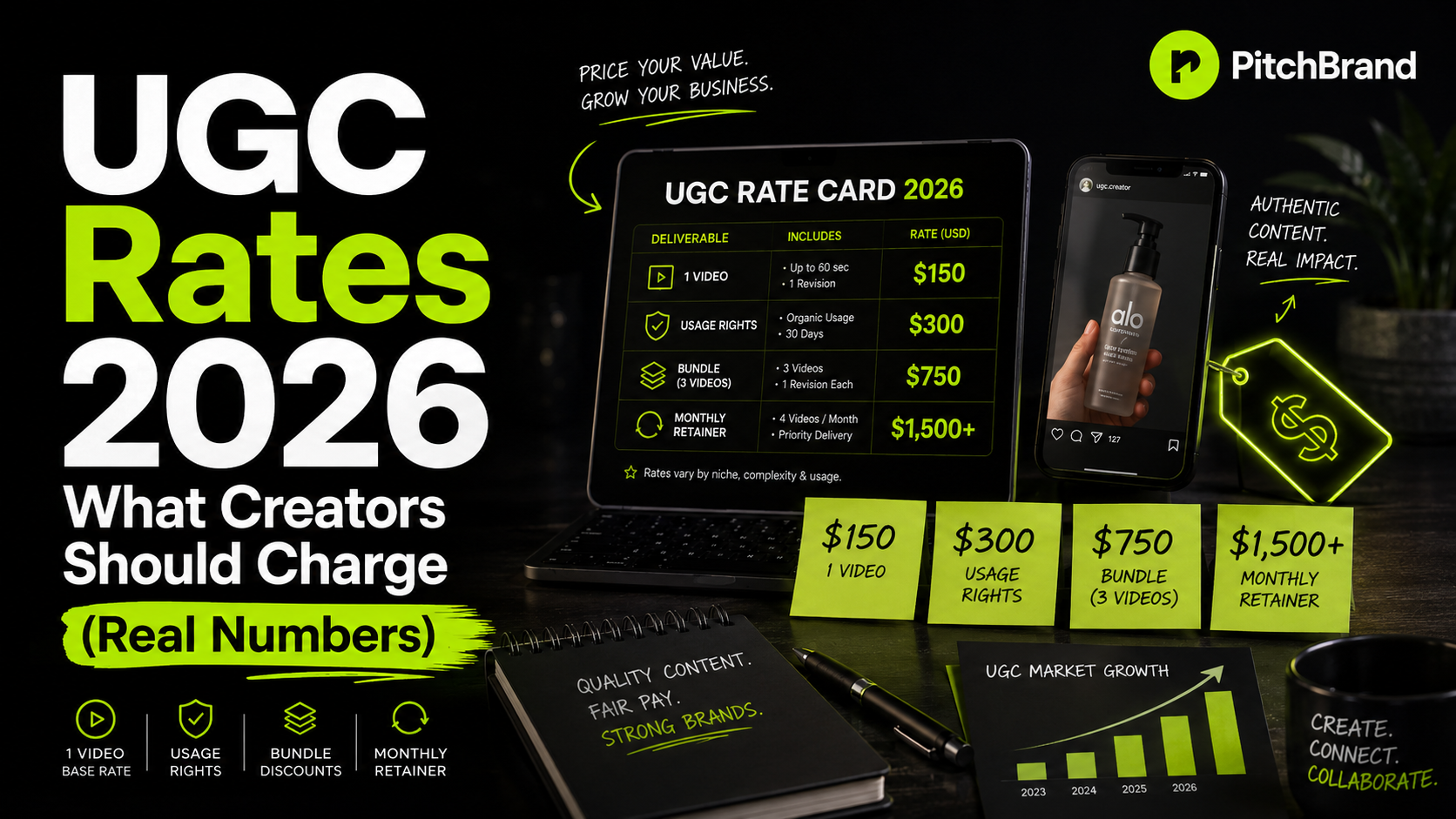
What are your UGC rates?
Charge $100 for a video, and you might be leaving $400 on the table.
If you quote a number that is too high, you will scare them away and lose the deal.
The gap between what you think you should charge and what brands are paying in 2026 is bigger than you realize, and it's costing you real money.
Usage rights now make up a bigger chunk of total pay than the content itself.
Niche also drives rates, and beginners are still underpricing themselves by 50% or more just because they don't know what normal looks like.
This guide breaks down 2026 UGC rates by experience level, content type, niche, and usage rights so you stop guessing and start pricing like a pro.
- Most professional UGC creators charge $500-$1,200 per video in 2026, with the broader market ranging $200-$3,000 depending on niche and rights (JoinBrands).
- Beginners typically start at $100-$500 per deliverable and can double or triple rates after 10-15 completed projects (InfluenceFlow).
- Usage rights and whitelisting can add 50-150% on top of your base rate — often more than the content itself.
- Niche drives huge swings: travel creators can hit $2,500 per video while fitness starts around $200 (UGC Roster).
- Bundling 5+ videos typically earns a 15-20% discount for the brand but locks in more predictable income for you (Veelapp).
What Are Typical UGC Rates in 2026?
UGC rates are different from traditional influencer rates because they are not determined solely by audience size but by deliverables.
UGC rates in 2026 typically range from $100 to $500+ per video for most creators, with photos running $50-$150 (Influee).
Professional creators with a strong portfolio charge $500-$1,200 per video, and top-tier or niche specialists can command $2,000-$3,000 per piece (JoinBrands).
The spread is wide because "UGC rate" depends on so many moving parts: your experience, the platform, whether the brand wants usage rights, and how competitive your niche is.
A single 15-30 second video without usage rights sits at the low end. Add whitelisting, a 60-second runtime, and a competitive niche like beauty or finance, and the same creator can charge three or four times as much.
Here's how pricing generally breaks down across sources tracking 2026 data:
Content Type | Typical 2026 Rate | Source |
|---|---|---|
UGC photo (single) | $30-$150 | Greater Than / Influence Flow |
15-30 second video | $100-$300 | Xolo / Launchpoint |
60+ second video | $150-$500 | Xolo |
Photo + video bundle | $300-$600 | Greater Than |
Raw footage only | Base rate minus 20-30% | Instagram creator data |
If you're just getting your pricing structured for the first time, it helps to build a simple creator invoice template so you're not scrambling every time a brand says yes.
UGC Rates by Experience Level
Beginner UGC creators charge $100-$500 per deliverable, mid-level creators charge $50-$150 per hour or $500-$1,200 per video, and creators with 10-15+ completed projects can often double their starting rates (InfluenceFlow).
Beginner Rates (0-5 completed projects)
If you're new, don't panic about low numbers; everyone starts here. Based on data creators are sharing publicly in 2026, typical beginner pricing looks like:
- 1 video: $100-$200
- Bundle of 3 videos: around $350
- Bundle of 5 videos: around $500
- UGC photos: $30 each, or 5 for $100
These numbers come from creators actively posting their beginner rate cards on Instagram in 2026.

Mid-Level and Experienced Rates
Once you've delivered 10-15 projects and have a portfolio to show, rates jump. Most experienced UGC creators charge $50-$150 per hour, or land somewhere in the $500-$1,200 per video range depending on the brand and deliverable (JoinBrands, InfluenceFlow).
At this stage, you're not just making content; you're solving a marketing problem, and brands pay accordingly.
This is also when creators start negotiating usage rights and whitelisting separately instead of bundling them into a flat fee.
Calculate Your Usage Rights (The Profit Multiplier)
This is where creators leave the most money on the table.
Your base rate covers the time and effort it takes to create the video. It usually includes standard organic usage for a limited time (like 3 to 6 months).
But if a brand wants to use your video as a paid advertisement to make themselves money, they have to buy a license.
To make sure you get paid fairly, review our comprehensive UGC usage rights pricing and licensing guide.
Stop guessing and use this simple industry-standard formula: Base Rate + (Base Rate x Usage % x Duration in Months) = Total Project Fee.
Here are the standard percentages you should charge:
Paid Ads (Social Media): 20% to 30% of your base rate, per month.
Website Usage: 25% of your base rate, per month.
Email Marketing: 15% to 20% of your base rate, per month.
Exclusive Rights: +75% to 200%, which prevents you from reselling to competitors.
For example, if your base rate is $150 and the brand wants 3 months of paid ad usage (at 25% per month), your usage fee is $112.50. Your total project fee becomes $262.50. You just increased your earnings by over 70% simply by pricing your usage rights correctly!
Never sign a contract for a "full buyout" unless they are paying you handsomely. A buyout or a contract that asks for rights "in perpetuity" is the brand asking you to sell them the house forever.
If you need help navigating this, read rights-managed vs unlimited UGC licensing explained.
Advance to High-Ticket Pricing Models
Once you have mastered your base rates and usage rights, it is time to level up. The highest-paid creators do not just sell single videos. They sell strategy and consistency.
Here are the advanced pricing models top creators use:
Value-Based Pricing: Tie your fees directly to the brand's expected ROI. The formula is 5% to 15% of projected campaign revenue. For a campaign estimated to drive $50,000 in sales, you charge $2,500 to $7,500.
Dynamic Pricing: Adjust your rates quarterly based on demand spikes, such as holiday seasons, or portfolio growth like viral content.
Retainer Agreements: Offer monthly packages for consistent income.
When you learn how to scale from 1-off UGC gigs to monthly retainers, your income becomes predictable.
A Starter Tier retainer might include 2 videos and 5 Stories for $1,500 per month. A Premium Tier could include 5 videos, 10 Stories, and an SEO blog for $4,000 per month.
Sound good? Let's talk about what happens when the brand says you are too expensive.
Master the Art of Negotiation
You sent your newly optimized rates over. The brand replies and says, "We love your work, but we only have half of that amount in our budget."
Do not panic. Do not immediately offer to cut your price in half.
When you know how to price UGC content, you negotiate on scope, not your hourly worth.
Here are three negotiation strategies to secure higher rates:
Anchor High: Start 25% above your target, then “discount” to your desired rate.
Bundle Strategically: Tell the brand, “For $2K, you'll get 3 TikToks + a 30-day usage license”. Note that brands often negotiate discounts when purchasing multiple pieces of content, such as discounting a $212 video to around $170 in a bundle of five.
Leverage FOMO: Create urgency by saying, “I have 2 slots left this month; let's finalize by Friday to lock this rate”.
If they push back aggressively on your rates, use this exact script:
"I understand budgets vary. My minimum for this scope is $X, but I'm happy to adjust deliverables to align with your goals."
By doing this, you maintain your professional boundaries while still trying to make the deal work.
Lock It Down with a Contract
You agreed on the price. You calculated the usage rights. You are ready to start filming.
Stop right there.
A massive mistake new creators make is skipping the contract. A contract is your only protection. We have seen countless creators get ghosted by brands after delivering the work, which a deposit prevents.
Do not rely on Instagram DMs to protect your business. Download and customize a simple UGC creator contract template to lock in your payment terms, deliverables, and usage rights.
Once the contract is signed and the deposit hits your bank account, you are officially in business.
Common UGC Pricing Mistakes to Avoid
The most expensive mistake creators make is failing to track what different brands paid, which leads to inconsistent, undocumented pricing across their whole business.
Quoting a single flat number without breaking out usage rights separately.
Not raising rates after landing 5-10 successful deals.
Ignoring niche value — pricing a finance or tech brand the same as a low-budget snack brand.
Losing track of past rates across dozens of email threads and DMs, which makes it hard to negotiate consistently.
Skipping a contract that spells out usage terms, deadlines, and revision limits.
That last point matters more than most creators realize; a badly worded contract can quietly sign away rights you never intended to give up. Before signing anything, it's worth reviewing red flags to watch for in brand contracts.
Take Control of Your Pricing
Figuring out your UGC rates 2026 strategy is the most empowering thing you can do for your career.
Stop guessing. Research your market, calculate your production costs, and clearly define your deliverables. Start applying these formulas to your current rate card and watch your income multiply simply by charging correctly for usage rights.
Are you ready to send your updated, professional pricing menu to brands that actually have marketing budgets?